
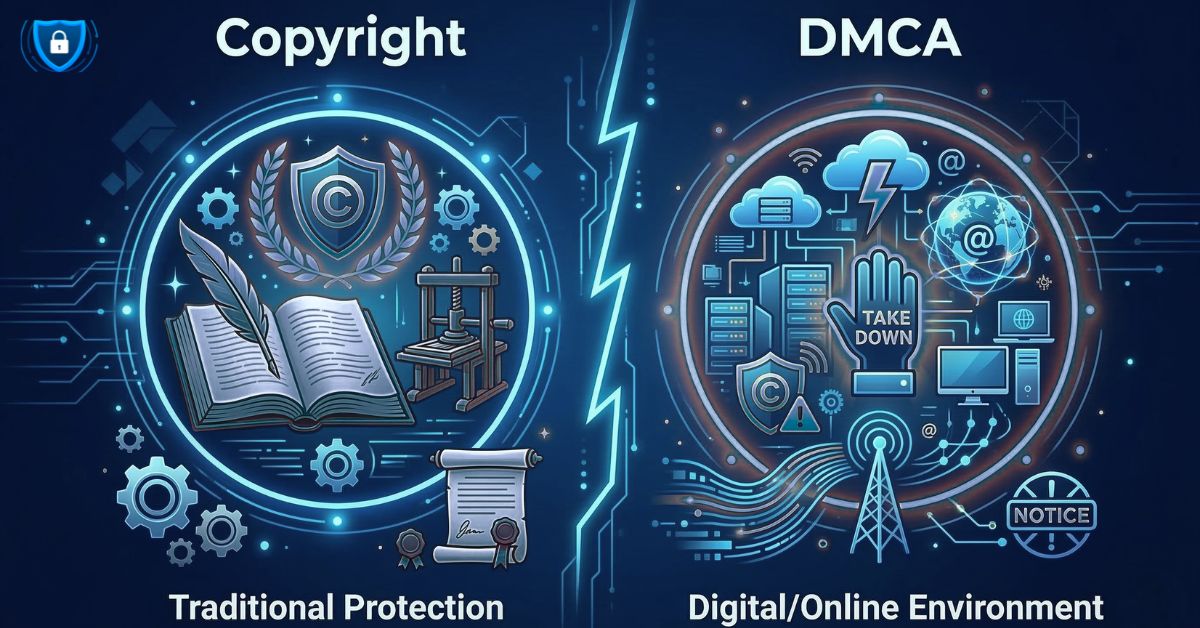
DMCA vs copyright is one of the most confusing topics online, and that confusion can cost creators time, traffic, and money. A lot of people think they are the same thing, but they are not. Copyright is the legal right that protects original creative work, while the DMCA is a U.S. law that helps deal with certain digital copyright problems, especially online takedowns and platform liability.
That basic difference matters fast when someone steals your work online. If you are trying to remove copied content from a website, marketplace, or platform, you usually need a DMCA takedown notice as the practical enforcement step, but that step only makes sense because copyright ownership exists underneath it.
Difference Between DMCA and Copyright
Now that the confusion is on the table, here is the simplest way to separate the two.
- Copyright gives creators legal rights over original works fixed in a tangible form. The DMCA is part of U.S. copyright law that deals with the digital environment, including notice-and-takedown rules for service providers and rules against bypassing access controls on protected works.
- That is why saying “I have DMCA” instead of “I own copyright” is not accurate. One is the right itself, and the other is a legal framework that helps enforce parts of that right online.
What Copyright Actually Protects
Now that the quick difference is clear, let’s look at copyright first. Copyright protects original works of authorship once they are fixed in a tangible medium, which can include blog posts, videos, photos, music, graphics, and software code.
That automatic protection is where many blogs stop, but an important detail comes next. You do not need registration for copyright to exist, yet registration can still matter a lot because it creates a public record and may unlock stronger litigation benefits, including possible statutory damages and attorney’s fees in a successful case.
In plain words, copyright is your ownership foundation. It is the reason you can license your work, stop unauthorized use, or push back when someone copies your content without permission.
What The DMCA Actually Does
Now that copyright is grounded, the DMCA makes more sense. The Digital Millennium Copyright Act was enacted in 1998, and one of its best-known parts is Section 512, which gives qualifying online service providers safe-harbor protection if they respond properly to copyright complaints and remove infringing content quickly.
But the DMCA is not only about takedowns. It also includes Section 1201, which restricts circumvention of technological measures that control access to copyrighted works, such as certain forms of digital locks or DRM.
This is one reason many search results feel incomplete. They often explain the takedown form but skip the bigger point: the DMCA is a digital-era copyright law with multiple moving parts, not just an email template to send when someone copies your page.
The Biggest Differences Between DMCA And Copyright
Now that both pieces are defined, the side-by-side comparison gets easier:
- Copyright is the core legal protection for original creative work.
- The DMCA is a specific U.S. copyright law built for digital issues like takedowns, safe harbors, and access controls.
- Copyright applies whether your work is online or offline.
- The DMCA becomes most visible when content is hosted on platforms, search engines, or websites, or when tech protection measures are involved.
- Copyright registration can strengthen your legal position, while a DMCA notice is usually the faster practical step for getting infringing content removed online.
When You Need Copyright And When You Need The DMCA
Now that the key differences are laid out, the real question becomes practical: when do you use which one? If someone republishes your blog post, steals your product photos, uploads your video, or copies your page word for word, copyright is the legal right you rely on, and the DMCA is often the tool you use to act fast on platforms and websites.
That is also where many site owners mix up legal buckets. If you are comparing brand misuse with copied content or invention theft, knowing the difference between copyright, trademark, and patent takedowns helps keep the categories straight, because the wrong notice slows everything down.
And because speed matters in real cases, a clean infringement reporting workflow matters in the middle of the process. Save the original URL, the infringing URL, screenshots, publish dates, and any files that show your authorship before you file anything.
Fair Use, Mistakes, And Counter-Notices
Now that enforcement is clear, it is just as important to talk about limits. Not every reuse is infringement, because U.S. copyright law also recognizes fair use, and courts weigh four factors when judging it.
That matters because bad takedowns do happen. Google says it can receive inaccurate or unjustified copyright removal requests, which is one reason creators should not treat every match, quote, or commentary use as automatic theft.
And because mistakes happen on both sides, the system also allows challenges. On YouTube, for example, a user who believes content was removed by mistake can submit a counter notification to try to restore it.
DMCA Vs Copyright In The New AI Landscape
Now that the older rules are clear, the AI era is where the conversation gets more complicated. The U.S. Copyright Office has said that material generated wholly by AI is not copyrightable under current U.S. law, while WIPO says generative AI is putting new pressure on copyright systems around the world.
That shift changes how creators should think about ownership. If a human meaningfully selects, edits, arranges, or transforms material, there may still be protectable human authorship in parts of the work, but a fully machine-generated output does not get the same clean answer.
In practice, that means many AI-age fights are really copyright questions first and DMCA questions second. The ownership, training-data, and authorship issues sit under copyright law, while a DMCA notice may still become useful later if copied outputs, scraped reposts, or infringing files are hosted online and need quick removal. This is an inference based on the Copyright Office’s current AI guidance and the DMCA’s online enforcement structure.
Common Mistakes People Make With DMCA Vs Copyright
Now that the AI wrinkle is out in the open, the everyday mistakes are easier to spot. The biggest one is thinking that the DMCA creates ownership by itself. It does not. Copyright ownership comes first, and the DMCA gives you certain digital tools and procedures after that.
Another common mistake is filing too fast without checking fair use, evidence, or the right legal category. A copied article, a fake product listing, a stolen logo, and a leaked paid course may each need a different response path, even if they all feel like “someone stole my stuff.”
One more mistake is ignoring the platform you are dealing with. Google, YouTube, and other services each have reporting systems, and learning the right route can save days of back-and-forth.
Final Thoughts For Bloggers, Brands, And Creators
Now that the terms are separated clearly, the best takeaway is simple: copyright is the right, and the DMCA is one of the digital enforcement frameworks built around that right. If you publish online often, you should have an idea of how DMCA protection for bloggers and content creators matters before a problem shows up.
And once that mindset is in place, your next move becomes much easier. Document your work, keep proof of authorship, register important assets when it makes sense, and use takedown systems carefully instead of reactively.
Frequently Asked Questions (FAQs)
No. Copyright is the legal protection for original creative work, while the DMCA is a U.S. law that deals with digital copyright issues such as safe harbors, notice-and-takedown, and access-control rules.
Yes. Copyright generally exists once an original work is created and fixed in a tangible medium, although registration can add important legal advantages if the dispute grows.
Yes. Platforms such as YouTube allow counter notifications when a user believes content was removed by mistake or misidentification.
You can use the platform’s legal reporting path to request removal or restriction based on copyright infringement. Google and YouTube both provide official reporting tools for this.
Under current U.S. Copyright Office guidance, material generated wholly by AI is not copyrightable, though human-created selection, arrangement, or editing may still matter.