
If you are searching for DMCA myths, chances are you are already dealing with a frustrating problem. Someone may have copied your blog post, reposted your image, uploaded your video, or reused your content in a way that makes you feel stuck, angry, and unsure what to do next.
That confusion gets worse because a lot of advice online mixes truth with outdated guesses. The good news is that the DMCA takedown process is real, structured, and meant to help copyright owners ask platforms and service providers to remove infringing content, and the U.S. Copyright Office even provides a sample takedown notice that shows what a compliant notice looks like.
Now that the process is clearer, let’s deal with the myths that waste the most time and cause the most damage.
What Are The Most Common DMCA Myths?
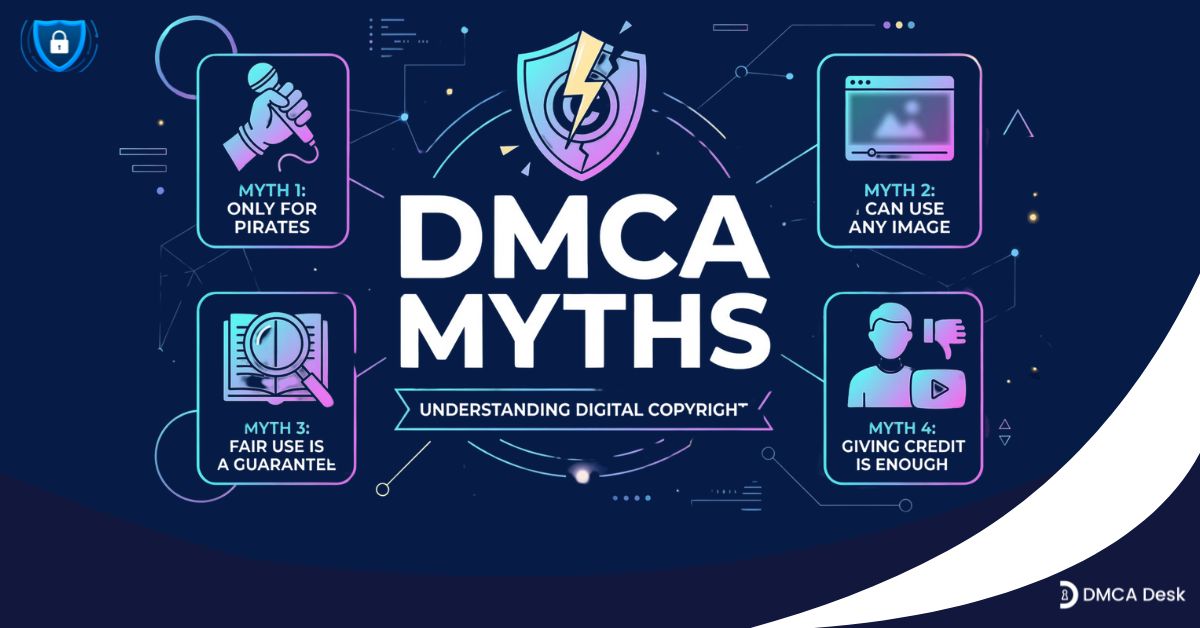
The most common DMCA myths are that you need copyright registration before sending a takedown, giving credit makes copying legal, fair use protects any short clip, and one takedown removes stolen content forever. In reality, the DMCA is a notice-and-takedown system that depends on a valid notice, platform action, and sometimes repeat follow-up.
What The DMCA Actually Does
Before the myths make sense, the basic rule needs to be simple. The DMCA gives online service providers a legal framework under Section 512 so they can limit liability if they respond properly to copyright complaints and follow notice-and-takedown rules.
That means a DMCA notice is not just an angry email. A valid notice needs the right details, such as what work was infringed, where the infringing material appears, your contact information, a good-faith statement, and your signature.
The Copyright Office also keeps a DMCA Designated Agent Directory so creators can find where notices should be sent.
1. You Need Copyright Registration Before Sending A DMCA Notice
Now that the law itself is clearer, the first myth to clear up is one that stops creators from acting fast. Many people think they cannot send a DMCA notice unless their work is already registered with the U.S. Copyright Office.
That is false. The U.S. Copyright Office says registration is not required before sending a takedown notice, even though registration is generally required before filing a copyright lawsuit over a U.S. work. In plain terms, you may still be able to ask for removal even if you have not registered the work yet.
For creators, this matters because delay helps infringers, not you. If your content is being copied right now, this myth should not keep you from taking the first step.
2. Giving Credit Makes The Use Legal
Once people learn registration is not required for a takedown, another myth usually shows up right away. Many users think that adding “credit to the owner” or tagging the creator somehow makes reposting legal.
It does not. YouTube’s copyright guidance states that giving credit does not automatically give someone the rights to use copyrighted content, and WIPO also explains that works posted online, including on social media, are generally protected and usually require permission before reuse.
That is why this myth is so dangerous. A copied post can still hurt your traffic, brand, and trust even when your name is attached to it.
3. Fair Use Protects Any Short Clip, Non-Profit Post, Or Educational Use
Since giving credit does not solve the problem, many people jump to fair use next. They say it was only a few seconds, they were not making money, or the use was educational, so it must be allowed.
That is not how fair use works. YouTube explains that even short uses can still create copyright problems, and fair use is decided case by case based on the facts, not by labels like “educational” or “non-profit.” The U.S. Copyright Office makes the same broader point: fair use is a legal question, not a shortcut phrase.
So the safer lesson for your reader is simple: fair use is not automatic, and short does not always mean safe.
4. One Takedown Notice Removes Stolen Content Forever
Now that fair use is out of the way, here comes the myth that causes the most false hope. A lot of people think that once a takedown goes through, the issue is over.
It often is not. The Copyright Office explains that platforms may receive counter-notices, and if a counter-notice is valid, content may be restored unless the copyright owner files a court action in time. On top of that, copied material can always appear again on a new page, a mirror site, or another platform.
This is why enforcement has to be bigger than one email. If piracy keeps spreading through duplicate uploads, download hubs, or repeat shares, it makes sense to guide readers toward torrent takedown services because takedowns work best when they are part of a wider cleanup plan, not treated like a one-time fix.
5. Platforms Have To Remove Content Within 24 Hours
Since creators want fast results, this next myth sounds believable. Many assume the law gives platforms a hard 24-hour deadline.
It does not. The Copyright Office says a service provider must act expeditiously, but that does not mean one fixed time frame for every platform and every case. In real life, response times vary based on the service, the notice quality, and the platform’s review process.
That is why clean reporting matters so much. A clear notice with exact URLs, screenshots, and ownership details usually moves faster than a vague complaint filled with emotion but light on facts.
6. The DMCA Only Works On U.S. Websites
Now that timing is in perspective, many creators start wondering about websites outside the United States. That question leads to another common myth: if the site is foreign, the DMCA is useless.
That is too simple. The U.S. Copyright Office says a notice may still be useful if the service targets U.S. users, but it also explains that foreign service providers are not automatically bound in the same way, and some countries use their own notice-and-takedown systems.
So the better message is this: do not assume the DMCA always works everywhere, but do not assume it is pointless either. Cross-border cases often need a layered strategy.
7. You Need A Lawyer Just To File A DMCA Notice
As the process starts sounding more formal, many creators get intimidated. They assume they need a lawyer or a big agency before they can even send a notice.
That is another myth. The U.S. Copyright Office says you do not need to hire an attorney to send a takedown notice as long as you are the copyright owner or authorized to act for the owner. It even provides sample forms to make the process easier.
That said, hard cases are different from simple cases. If the infringement is commercial, repeated, or spread across many sites, this is where broader infringement reporting becomes a smarter next step than handling each copy one by one.
8. If Content Is On Social Media, It Is Free To Reuse
Now that the filing myths are easier to spot, the social media myth deserves its own attention because it causes constant damage. People still assume that if a photo, reel, or video is public, it is free to repost.
WIPO says that works published online, including on social media platforms, are generally protected by copyright, which means permission is usually needed unless a clear exception applies. That is why creators need better habits before theft happens, and this is also the right point to naturally guide readers toward your post on how to protect your creative content on social media, because smart protection starts with ownership records, evidence capture, and quicker reporting, not just reacting after the damage is done.
What Creators Should Do Instead Of Believing DMCA Myths
After all these myths, the practical path becomes much easier to see. Save original files, record publish dates, capture screenshots, collect exact URLs, and identify the copied material clearly before you report it.
Then send a notice that is specific and complete. The Copyright Office’s sample notice shows the basic structure, and the agent directory helps you find where the notice should go when a platform or host does not make that step obvious.
The AI Revolution In Copyright Detection Is Changing Enforcement
As enforcement gets more complex, a newer shift is starting to matter: AI-driven detection and provenance tools. NIST says synthetic content detection can rely on metadata, digital watermarks, and other signals, while C2PA’s Content Credentials framework is built to show the history and source of digital media in a more verifiable way.
And that shift is moving beyond theory. Research such as CopyJudge explores automated ways to assess substantial similarity in image copyright disputes, while NIST notes that watermarking can support copyright-related provenance checks. The exciting part is speed, but the caution is just as important: detection tools can surface likely matches faster, yet human review still matters because “similar” and “infringing” are not always the same thing.
What Smart Creators Should Remember
After all of this, the real lesson behind DMCA myths is not that the system is broken or perfect. It is that creators lose when they trust internet folklore and win when they understand the rules, gather evidence, send the right notice, and follow through when copied content comes back.
That is the mindset shift that matters most. The DMCA is not magic, but it is a real process, and when you use it the right way, it gives you a clearer path to protecting what you created.
Frequently Asked Questions (FAQs)
No. The U.S. Copyright Office says registration is not required before sending a takedown notice, although it is usually required before filing a copyright lawsuit over a U.S. work.
No. Giving credit does not automatically create permission to use copyrighted content. Rights, licenses, or a valid legal exception are what matter.
Yes. Short length alone does not make a use legal. Fair use depends on the facts, and even brief clips can still raise copyright issues.
Yes. A counter-notice may lead to reinstatement, and infringing content can also be uploaded again elsewhere.
No. Copyright owners and authorized representatives can send takedown notices themselves.
Usually, yes. WIPO explains that works posted online, including on social media platforms, are generally protected by copyright.