

In this topic, we are going to understand how global copyright protection works. You create, you write, and someone else copies. You lose control, you lose revenue, and this is my content, vibe. With copyright protection, you can avoid this nuisance. Copyright protection doesn’t exist in specific countries, but it exists across borders. It is a strong barometer that can help you remove stolen content and stop monetization in many cases.
We will explore how copyright protection works globally, how treaties and platform rules interact, and most importantly, what to do when your work is stolen. This guide is written based on hands-on experience handling DMCA removals, cross-border DMCA takedown notices, and enforcing copyright for global creators and brands.
What Is Global Copyright Protection and How Does It Work?
Copyright protects original expressions, not ideas. That means that written text, images, videos, codes, and audiovisual content that you produce are protected as soon as they come in tangible forms. No registration is required for this. This automatic protection principle is a cornerstone of international copyright law.
1. Works Protected Under Copyright
Copyrights cover literary works, musical works, films, photos, software, websites, product descriptions, and much more.
2. What Copyright Does Not Protect
But you should keep in mind that there are things that copyright does not cover. It doesn’t cover raw ideas, facts, short phrases, or generic templates. Automatic protection at creation was formalized by the Berne Convention, and it is recognized by most countries.
Global Copyright Protection Across Countries
Three international mechanisms matter most in this regard
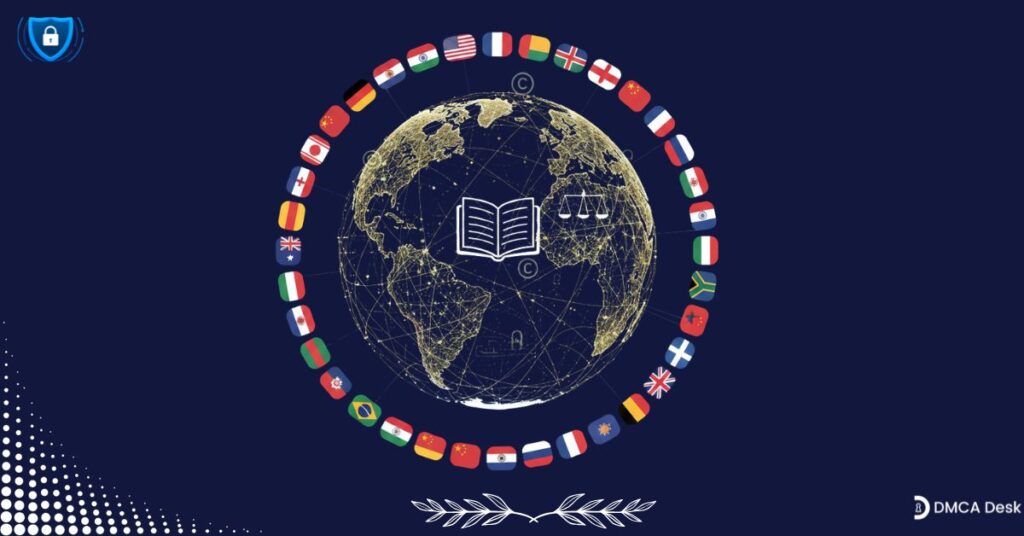
1. The Berne Convention: Automatic Protection in 181+ countries
The Berne Convention sets minimum rules, including national treatment, minimum duration, and protection of rights, and ensures that creators from member states receive the same treatment abroad as locals. Most countries are party to the Berne Convention. This is the reason that when you create work in one country, it is protected in others
2. WIPO: Organization that sets Global Copyright Protection Standards
WIPO helps coordinate treaties, publishes guidance, provides resources, and offers dispute mechanisms. WIPO doesn’t enforce, but it creates standards and serves as the knowledge hub for global copyrights
Digital Copyright Enforcement
For online content, the DMCA has transformed enforcement by providing a takedown mechanism that protects platforms under the safe harbor provision if they remove infringing content upon notice. That system-shaped platform behaviour globally and is mirrored across many services.
Step-by-step DMCA takedown process
- Identify the infringing URL
- Send a DMCA notice to the platform or hosting provider according to the Digital Millennium Copyright Act.
- Optionally file notices with search engines to delist pages like Google/Bing
- For persistent infringers, escalate to the host/registrar, payment processors, ad networks, or legal action.
Platforms have different processes, like YouTube uses strikes while GitHub has a DMCA procedure, including platform-specific steps in process docs.
Cross-Border Enforcement: What Works vs. What Fails
It works very well on major US-based platforms like YouTube, Meta, Shopify, and Google because of DMCA-style procedures and cloud hosting business models. You can often get the content removed even if the uploader is overseas.
Sites hosted in jurisdictions with weak enforcement and anonymity protections, peer-to-peer networks, or cases that raise conflicts with local free speech or moral exceptions. Offshore hosting complicates takedowns and requires registrar or hosting escalation.
Use a combination of platform notice with the host or registrar, plus search delisting and monetization blocking.
Copyright Myths That Waste Your Time
- It is a common myth that you must register a copyright. But the truth is that registration helps with enforcement in some jurisdictions, but automatic protection exists under Berne.
- There is also an ongoing myth that small changes make content legal, but the truth is that substantial similarity matters; simply changing words won’t avoid infringement.
- Another popular myth is that DMCA fixes everything. No doubt that DMCA is powerful on hosted platforms, but not a silver bullet against anonymous offshore operators
What To Do When Someone Steals Your Content
- Document the infringement: take full-page screenshots, record URLs, and collect timestamps.
- Confirm ownership: keep original URLs, time, and date of creation, and metadata.
- Send a DMCA notice to the platform.
- If the platform refuses to take action, you can also escalate to the hosting provider, the domain registrar, and ad networks running monetization.
- File a search engine delisting: to limit discoverability
- Take help from DMCA agents to handle the takedown process effectively
Imagine posting a product photo on Instagram, then finding an entire store in Dubai running paid ads with your image. That’s where DMCA Desk steps in; you focus on growth; we handle the takedowns.
1. DMCA Takedown Template
DMCA takedown template contains your name, contact info, identification of copyrighted works, location of infringing materials, statement of good faith belief that use is not authorized, statement under penalty of perjury that information is accurate, and at the end, your electronic signature, which is allowed on hosted platforms
2. Common Questions that Creators ask
Creators usually ask if I need to register my work globally. No international treaties contain automatic protection the moment you create something; registration helps with certain remedies, e.g, statutory damages in US courts. Another query that they most commonly ask is Will this stop all copying? No, but it drastically reduces visibility and revenue streams for infringers.
In this ongoing era of AI automation, creators mostly ask about AI content, whether you can claim copyright on it or not. It really depends; if it’s substantially original and has human input, rights can arise. This is evolving fast. Keep a record of prompts and edits.
How DMCA Desk Helps Creators and Businesses
DMCA Desk helps combine legal know-how with the platform experience to remove stolen content worldwide: DMCA notices, social media takedowns, domain name dispute resolution, and torrent takedown notices.
You should treat copyright protection like insurance. There is low friction to set up, like clear notices, originals, and monitoring, but high payoffs when theft happens. When someone steals your content, move fast, document everything, and use the treaty and platform systems already designed to protect you.